Art Deco Furniture: Complete History, Design Principles & Modern Master Craftsmanship
Art Deco furniture represents one of the most influential and enduring design movements in modern history. Defined by bold geometry, luxurious materials, and architectural precision, Art Deco continues to shape high-end interiors and custom furniture design nearly a century after its peak.
This comprehensive guide explores the full history of Art Deco furniture, from its origins in early 20th-century Europe to its modern revival in custom, handcrafted work. Whether you're a collector, designer, or client seeking custom Art Deco furniture, this page serves as a definitive resource.
At Joel Liebman Furniture, these principles are not studied—they are actively practiced, refined, and brought forward into the present.
Origins of Art Deco Furniture (1910–1925)
Art Deco emerged in the early 1900s as a response to the ornate, organic forms of Art Nouveau. Influenced by Cubism, industrialization, and advancements in engineering, designers began embracing symmetry, structure, and modern materials.
Key influences included:
Machine-age precision
Classical symmetry
Global decorative motifs (Egyptian, African, Asian)
Early modernist architecture
This shift marked the beginning of modern furniture design as both art and engineered object.
The 1925 Paris Exposition & Global Influence
The defining moment came in 1925 at the Exposition Internationale des Arts Décoratifs et Industriels Modernes in Paris.
This exhibition established:
The global identity of Art Deco
A new standard for luxury furniture
The fusion of craftsmanship with modern aesthetics
From this point forward, Art Deco furniture became synonymous with sophistication, exclusivity, and elite design.
The Golden Age of Art Deco Furniture
(1925–1940)
The period between 1925 and 1940 represents the peak of Art Deco furniture design.
During this era:
Furniture was handcrafted for affluent clients
Designers prioritized both visual impact and material excellence
Pieces were often custom-built, not mass-produced
Common forms included:
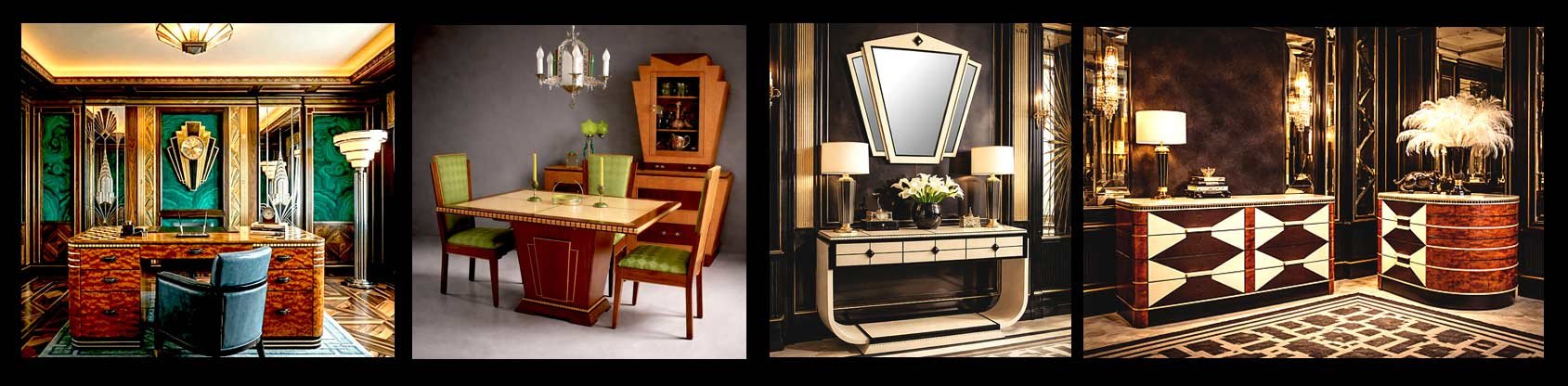
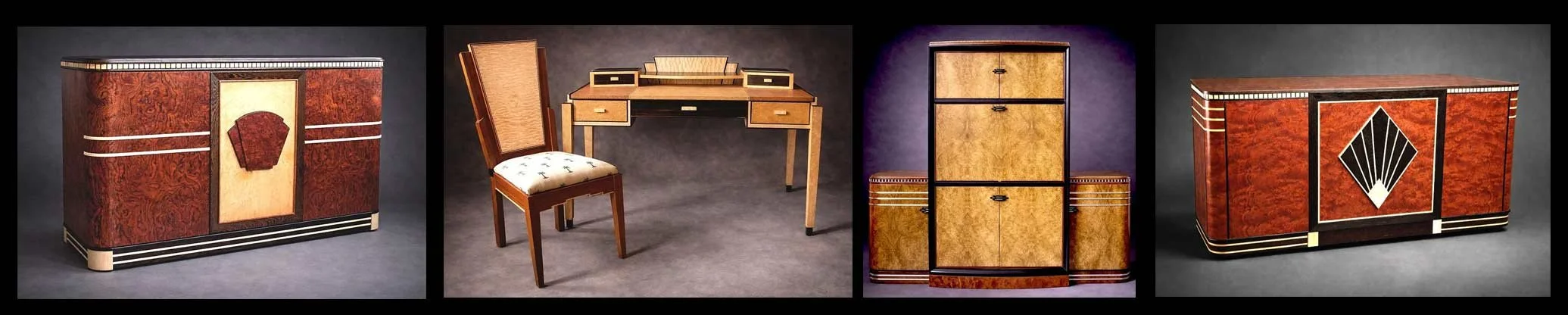
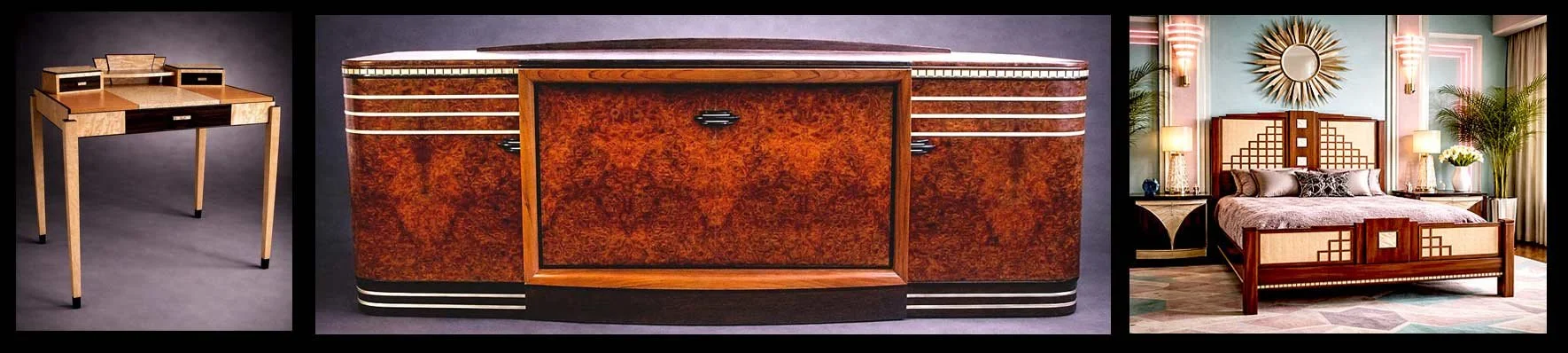
Art Deco desks with bold geometric structures
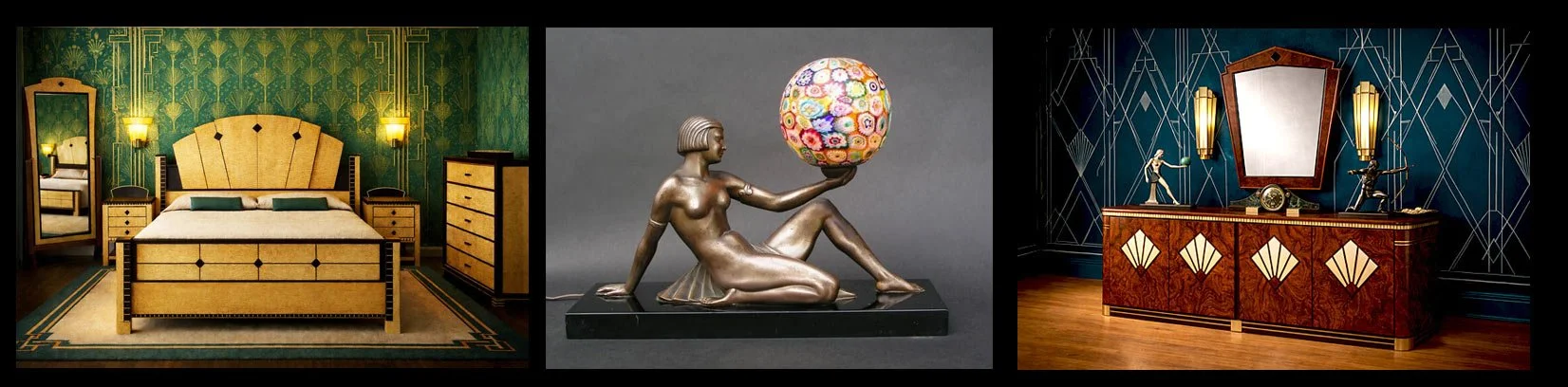
Custom credenzas with exotic veneers
Streamlined cabinets integrating metal and lacquer
Architectural beds with symmetrical framing
This was not casual furniture—it was statement design rooted in precision and permanence.
Materials Used in Art Deco Furniture
Authentic Art Deco furniture uses premium materials such as:
Macassar ebony
Rosewood and walnut veneers
Lacquer finishes
Polished metals (chrome, brass)
Glass and stone inlays
Architectural Influence
Art Deco furniture often mirrors architectural elements—columns, setbacks, and structural rhythm. NYC Chrysler Building
and South Beach Miami are just two of many that stand out. Many great examples spread throughout the globe including New Zealand, France, China, Argentina, Brazil, South Africa, Germany and Greece.
Art Deco Furniture vs. Modern
Mass Production
Most furniture labeled “Art Deco” today is:
Mass-produced
Veneer-heavy with minimal craftsmanship
Designed for visual imitation, not structural integrity
True Art Deco furniture—historically and today—is defined by:
Hand craftsmanship
Precision joinery
Material integrity
Custom design execution
The Decline of Art Deco
& Shift to Modernism
With the onset of World War II, Art Deco declined due to:
Material shortages
Economic shifts
Changing design preferences toward minimalism
Postwar modernism favored simplicity over ornamentation, pushing Art Deco out of mainstream production.
However, its influence never disappeared—it evolved.
Art Deco Furniture Today
(Modern Revival)
Beginning in the mid-20th century and accelerating today, Art Deco has seen a strong revival in:
Luxury interior design
Boutique hospitality spaces
High-end residential furniture
Collectors and designers are drawn to Art Deco because it offers something rare:
bold identity combined with refined craftsmanship
Search demand today reflects this resurgence:
“Art Deco furniture for sale”
“custom Art Deco cabinet maker”
“Art Deco desk handcrafted”
Custom Art Deco Furniture
in the Modern Era
Today, the highest level of Art Deco furniture exists almost exclusively in custom, made-to-order work.
People are no longer looking for generic reproductions—they are searching for:
One-of-a-kind pieces
Exact dimensional control
Material customization
Design that fits both architecture and lifestyle
This is where true craftsmanship re-enters the conversation.
Custom Art Deco Furniture
by Joel Liebman
Joel Liebman Furniture represents a rare category within the market:
a true continuation of Art Deco design principles through modern craftsmanship.
Each piece is:
Designed with architectural intent
Built using premium, carefully selected materials
Handcrafted with precision joinery and finishing
Tailored to the client’s exact specifications
Rather than replicating historical pieces, the work advances the tradition—creating modern Art Deco furniture that stands alongside the originals in quality and presence.
Why Art Deco Furniture
Still Defines Luxury Design
Art Deco endures because it represents a level of intention that is increasingly rare.
It is:
Structured, not improvised
Crafted, not manufactured
Designed for permanence, not trend cycles
For clients seeking furniture that reflects status, taste, and architectural clarity, Art Deco remains one of the strongest design languages available.
What defines Art Deco furniture?
Art Deco furniture is defined by geometric design, symmetry, high-end materials, and a balance between craftsmanship and modern aesthetics. When you see it, you know it.
Is Art Deco furniture still made today?
Yes—but primarily by custom furniture makers specializing in handcrafted, high-end work rather than mass production.
Why is Art Deco furniture expensive?
Authentic Art Deco furniture requires high-quality materials, precision craftsmanship, and significant labor, especially in custom pieces.
Iconic Art Deco Furniture Designers
Émile-Jacques Ruhlmann — Widely considered the master of Art Deco furniture; known for exquisite materials, refined proportions, and uncompromising craftsmanship.
Jules Leleu — Elegant, restrained luxury with exceptional marquetry and fine detailing.
Paul Follot — Bridged Art Nouveau and Art Deco with richly decorative, traditional influences.
André Groult — Known for soft forms, luxurious woods, and subtle femininity in design.
Jacques-Émile Ruhlmann — (Often referenced under this full name in design history.)
Jean-Michel Frank — Minimalist Art Deco; master of understatement using rare materials like shagreen and parchment.
Eileen Gray — A pioneer blending Art Deco with modernism; iconic for lacquer and tubular steel pieces.
Paul Dupré-Lafon — Luxurious, architectural furniture with bold use of leather and exotic woods.
Donald Deskey — Brought Art Deco into American mass production and interiors (notably Radio City Music Hall).
Gilbert Rohde — Helped modernize American furniture with streamlined Art Deco forms.
Influential Art Deco Architects
William Van Alen — Designer of the iconic Chrysler Building; a defining symbol of Art Deco architecture.
Raymond Hood — Key figure behind Rockefeller Center and other landmark Deco structures.
Ralph Thomas Walker — Known for bold, sculptural skyscrapers like the Barclay–Vesey Building.
Eliel Saarinen — Influential in shaping early modern and Deco transitions in architecture.
Timothy L. Pflueger — Designed richly detailed Art Deco theaters and interiors in California.
Joseph Urban — Integrated architecture, interiors, and stage design in a cohesive Deco vision.
Cass Gilbert — Early adopter of Deco elements in skyscraper design.
Shreve, Lamb & Harmon — Designers of the Empire State Building, blending Deco styling with monumental scale.
In Closing:
Art Deco is not simply a historical style—it is a benchmark for what furniture can achieve when design, material, and craftsmanship are executed without compromise.
While the movement reached its peak nearly a century ago, the principles that defined it—precision, proportion, and material excellence—remain as relevant today as ever. What has changed is not the standard, but the rarity of those capable of meeting it.
In the modern era, true Art Deco furniture exists almost exclusively in custom, handcrafted work. It demands not only an understanding of the movement’s visual language, but the technical ability to execute it at the highest level.
Joel Liebman Furniture operates within that rare space—where each piece is designed with architectural intent, built from exceptional materials, and crafted to reflect the enduring standards established during Art Deco’s golden age.
For those seeking authentic Art Deco furniture—built with intention, material integrity, and architectural clarity—the difference is unmistakable.